Why Certifications Matter for Haircare Brands
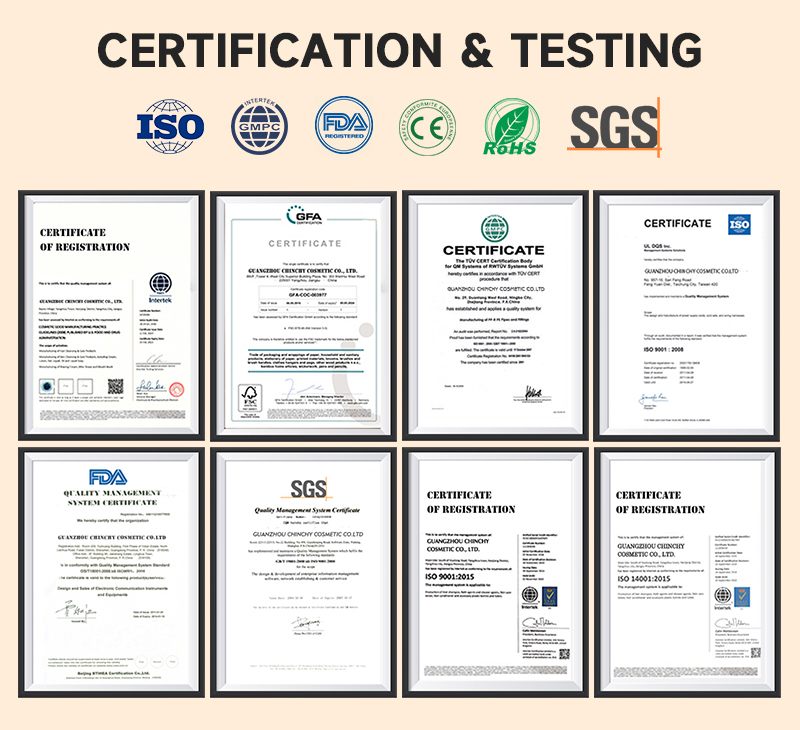 Every Ecolchi hair treatment is manufactured in GMP-certified facilities — the quality standard international buyers demand from their haircare OEM manufacturer.
Before diving into specific certifications, let’s address why this is so important:
- Market access: Most countries require evidence of Good Manufacturing Practice compliance before allowing cosmetics import
- Retail requirements: Major retailers (Sephora, Ulta, Boots, etc.) won’t stock products without verified quality certifications
- Consumer trust: Certifications are visible proof of quality that builds consumer confidence
- Legal protection: Certified manufacturing protects you from liability if quality issues arise
- Premium positioning: Brands manufactured in certified facilities can command higher prices
Essential Certifications for Haircare OEM Manufacturers
1. GMP (Good Manufacturing Practice)
Full name: Good Manufacturing Practice (GMP) / Cosmetics GMP
What it is:
GMP is a quality assurance system that ensures products are consistently produced and controlled according to quality standards. For cosmetics, GMP covers every aspect of production—from incoming raw material inspection to finished product release.
Key requirements under GMP:
- Premises: Clean, sanitary manufacturing environment with proper layout and maintenance
- Equipment: Calibrated, cleaned, and maintained equipment
- Personnel: Trained staff with appropriate qualifications
- Materials: Incoming material inspection and approval
- Production: Documented procedures at every stage
- Quality control: In-process testing and finished product testing
- Documentation: Complete records for every batch (traceability)
- Complaints: Systematic handling of consumer complaints
- Self-inspection: Regular internal audits
Why it matters for haircare:
Hair products come into direct contact with the scalp and skin—making microbial contamination, ingredient degradation, and cross-contamination genuine safety concerns. GMP ensures the manufacturing environment and processes minimize these risks.
Which markets require GMP:
- USA: FDA expects voluntary GMP compliance (21 CFR Part 110)
- EU: Mandatory under EU Cosmetics Regulation (EC) No 1223/2009
- Canada: Mandatory under Health Canada Cosmetic GMP
- Most export markets: De facto requirement for international trade
2. ISO 22716 (Cosmetics — Good Manufacturing Practices)
What it is:
ISO 22716 is the *international standard* specifically for cosmetics Good Manufacturing Practices. It was published by the International Organization for Standardization (ISO) in 2007 and provides globally recognized guidelines for cosmetics manufacturing.
ISO 22716 is built on the same principles as GMP but adds an international harmonization layer—making it the gold standard for manufacturers that export globally.
The 7 pillars of ISO 22716:
1. Personnel – Training, hygiene, and qualifications
2. Premises – Building, facilities, and sanitation
3. Equipment – Design, maintenance, and calibration
4. Materials and articles – Raw material and packaging control
5. Production – Manufacturing controls and in-process checks
6. Finished products – Testing and release procedures
7. Quality assurance – Documentation, deviations, and complaints
Why it matters:
ISO 22716 is recognized in over 160 countries and is increasingly required by retailers and importers as proof of quality compliance. An ISO 22716 certified haircare manufacturer can ship to virtually any global market with confidence.
Certification body: ISO 22716 certification is issued by third-party auditors (accredited certification bodies like SGS, Bureau Veritas, TÜV).
—
3. ISA 22716 (International Standards Authority)
What it is:
ISA 22716 is sometimes confused with ISO 22716—but it’s a different certification body (International Standards Authority) that also provides GMP certification for the cosmetics industry.
In practice, when buyers say “ISA 22716 certified,” they’re referring to GMP certification issued by ISA against the ISO 22716 framework.
What to look for:
- ISA certification against ISO 22716 guidelines
- Or: Direct ISO 22716 certification from an accredited body
The important thing is that the standard itself aligns with ISO 22716—the certifying body is less critical than the rigorous application of the standard.
—
4. ISO 9001 (Quality Management Systems)
What it is:
ISO 9001 is the international standard for Quality Management Systems (QMS). While not cosmetics-specific, it demonstrates that a manufacturer has systematic processes for ensuring consistent quality and continuous improvement.
Why it matters:
ISO 9001 is often the baseline certification that buyers look for when evaluating any manufacturing partner. It’s evidence that the company has documented processes, tracks performance, and has mechanisms for addressing non-conformances.
For haircare specifically:
ISO 9001 alone is insufficient—it’s too generic. But when combined with ISO 22716 (cosmetics-specific GMP), ISO 9001 demonstrates a manufacturer that takes quality seriously at an organizational level.
—
5. ISO 14001 (Environmental Management)
What it is:
ISO 14001 is the international standard for Environmental Management Systems. It demonstrates that a manufacturer has processes in place to minimize environmental impact.
Why it matters for haircare brands:
Consumer demand for sustainable and clean beauty is at an all-time high. If your brand markets itself as eco-friendly or sustainable, manufacturing in an ISO 14001 certified facility gives you credibility for your environmental claims.
—
6. FDA Registration (for US Market Entry)
What it is:
The FDA (U.S. Food and Drug Administration) regulates cosmetics under the Federal Food, Drug, and Cosmetic Act. While FDA registration is technically voluntary for most cosmetics, it’s strongly recommended for any manufacturer exporting to the United States.
Key requirements:
- Facility registration with the FDA (for U.S. manufacturers or foreign facilities exporting to the U.S.)
- Cosmetic product listing with the FDA (required for products marketed in the U.S.)
- Compliance with the Modernization of Cosmetics Regulation Act (MoCRA) of 2022, which introduced new requirements including:
- Facility registration (mandatory)
- Product listing (mandatory)
- Adverse event reporting
- Good Manufacturing Practice requirements
Why it matters:
Without FDA-compliant manufacturing, your products can be detained at U.S. ports and banned from sale in the world’s largest beauty market.
—
7. ECOCERT / COSMOS (Natural and Organic Claims)
What they are:
- ECOCERT: A certification organization that verifies natural and organic ingredients/processes
- COSMOS: The European standard for organic/natural cosmetics (Certified by ECOCERT and other bodies)
Why they matter:
If your brand markets natural haircare, clean beauty, or organic products, you need your manufacturer to be certified by ECOCERT or equivalent. Using natural ingredient claims without certification is both legally risky and increasingly called out by informed consumers.
What they certify:
- Minimum percentage of natural ingredients
- Organic ingredient percentages
- Prohibited ingredient lists
- Environmental manufacturing practices
- Sustainable sourcing requirements
8. MSDS (Material Safety Data Sheet)
What it is:
An MSDS (now called SDS – Safety Data Sheet) is a document that provides detailed information about a chemical substance—including its hazards, safe handling procedures, and emergency measures.
Why it matters:
For haircare manufacturers, MSDS documentation is essential for:
- Customs clearance (required by most importing countries)
- Air freight compliance (required for shipping by air)
- Regulatory submissions (required for EU and many Asian market registrations)
- Workplace safety (required for manufacturing staff handling)
Most reputable haircare OEM manufacturers will provide MSDS documentation for their products as part of standard export documentation.
—
9. Cruelty-Free and Leaping Bunny
What they are:
- Cruelty-free: A general term indicating no animal testing at any stage of product development
- Leaping Bunny: The gold standard cruelty-free certification in North America
Why they matter:
Consumer demand for cruelty-free haircare is enormous—and growing. An estimated 62% of global consumers say they’re more likely to buy from brands that don’t test on animals (Consumer Insights Survey, 2023).
For manufacturers:
Cruelty-free certification requires documentation of:
- No animal testing at any stage (ingredients or finished product)
- Third-party supply chain audits
- Annual recertification
—
Certifications Matrix: Which Markets Require What
—
What to Ask Your Haircare Manufacturer
When evaluating an OEM haircare manufacturer, ask for:
1. Copies of all certification certificates (not just claims—actual certificates)
2. Last audit dates — How recently were they audited?
3. Audit reports — Can they share a summary or redacted version?
4. Scope of certification — Which products and processes are covered?
5. Third-party verification — Who issued the certification (accredited body or self-declared)?
6. Corrective action records — What happened when non-conformances were found?
7. Export experience — What markets have they successfully exported to?
—
Red Flags: Certifications to Be Wary Of
🚩 “We are GMP compliant” but no certificate — Ask for documented proof
🚩 Self-declared certifications — Look for third-party accredited certification bodies
🚩 Expired certificates — Verify the current validity of all documents
🚩 Narrow scope — Make sure the certifications cover the specific products you want to source
🚩 Reluctance to share documentation — A confident manufacturer will share certificates readily
🚩 Only domestic certifications — If you’re exporting, you need internationally recognized standards
Why Ecolchi’s Parent Company Stands Out
Guangzhou Chinchy Cosmetics Co., Ltd. (Ecolchi’s parent company) holds a comprehensive portfolio of certifications:
- ✅ GMP (Good Manufacturing Practice)
- ✅ ISO 9001 (Quality Management System)
- ✅ ISA 22716 (International GMP Standard)
- ✅ MSDS documentation for all products
- ✅ FDA-compliant manufacturing
- ✅ Custom formulations available with additional certifications (ECOCERT, COSMOS, cruelty-free) upon request
With nearly 20 years of experience and products sold in over 100 countries, Ecolchi’s manufacturing capabilities are built on a foundation of rigorous quality assurance and international compliance.
—
Final Checklist: Your Manufacturer Certification Checklist
Before signing with any haircare OEM manufacturer, confirm:
- [ ] GMP Certification (certificate + audit date)
- [ ] ISO 22716 or equivalent Cosmetics GMP certification
- [ ] ISO 9001 Quality Management System
- [ ] FDA registration/compliance (if targeting USA)
- [ ] MSDS documentation available
- [ ] Third-party accredited certification bodies
- [ ] Export documentation support
- [ ] Product liability insurance
- [ ] Custom certification capabilities (if needed: ECOCERT, COSMOS, Leaping Bunny)
Certifications aren’t optional add-ons—they’re the foundation of a trustworthy supply chain. Choose a manufacturer that treats quality compliance as a core business value, not a marketing checkbox.
Ready to work with a certified haircare manufacturer? Ecolchi’s manufacturing team holds GMP, ISO 9001, and ISA 22716 certifications—and offers full export documentation support for brands entering markets worldwide. Contact them at ecolchifactory.com →